

How Shopify Localization Helps Ecommerce Brands Expand Internationally
How Shopify Localization Helps Ecommerce Brands Expand Internationally
For design-led brands, experience matters.
The same attention that goes into a product, a space, or a visual identity should also extend to the way customers experience a brand online. That becomes especially important when a company begins expanding internationally.
For many ecommerce brands, international demand appears long before the infrastructure exists to support it. Customers from Europe begin appearing in analytics, orders slowly start coming in from markets like France, Germany, and the UK, and brands realize that their audience is no longer limited to one geography.
But in many cases, the online store was never designed with those customers in mind. Pricing appears only in U.S. dollars, shipping timelines are long, and the buying experience feels slightly disconnected from how customers in those markets actually shop.
As brands grow, that gap becomes harder to ignore.
At FORTUNE Marketing, a boutique digital marketing agency working with design-led brands in fashion, architecture, interiors, and hospitality, we often help companies bridge that gap by translating strong brand experiences into digital infrastructure. One recent project involves helping a U.S.-based ecommerce brand expand into Europe using Shopify Markets and a localized storefront strategy.
When Logistics and Digital Experience Need to Evolve Together
In this case, the brand is opening a warehouse in Europe to significantly reduce fulfillment times for European customers. Instead of waiting for international shipments from the United States, customers across the EU will soon receive orders faster and at a lower shipping cost.
But improving logistics is only part of the equation.
If the online store still presents everything in USD, offers generic international shipping, and forces European customers to navigate an English-only interface, the experience still feels foreign.
That is where Shopify localization becomes essential.
Using Shopify Markets to Build Regional Storefront Experiences
Shopify Markets allows brands to create region-specific storefront experiences while maintaining a single backend store. Instead of managing separate websites for each country, brands can structure their store so that visitors automatically see the version of the site tailored to their market.
For this project, we created several localized storefront markets within Shopify:
-
France, with a fully translated French-language storefront
-
Germany, with German localization for one of the brand’s largest non-English-speaking audiences
-
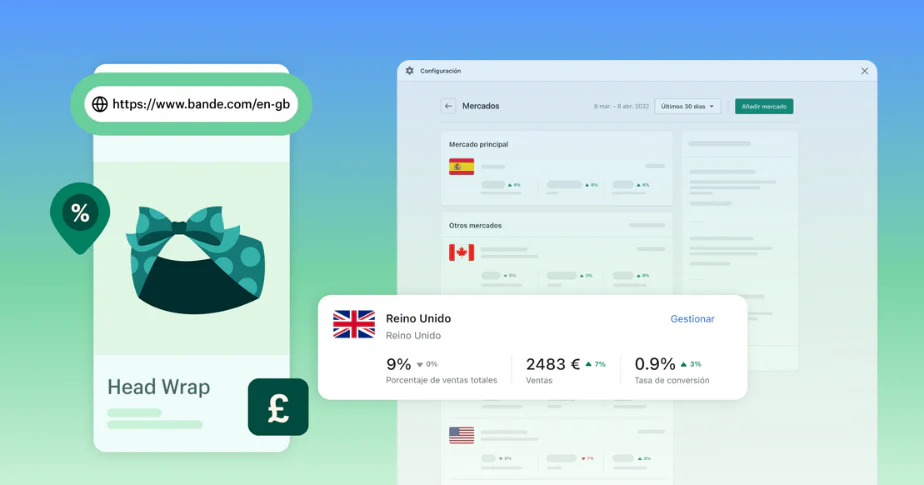
United Kingdom, with pricing in GBP and localized shipping options
-
Rest of Europe, with an English storefront optimized for EU customers
When customers arrive on the site, they are automatically directed to the storefront designed for their region. That means they immediately see pricing in their own currency, shipping timelines from the European warehouse, and a language experience that feels natural.
For ecommerce brands, even small improvements in familiarity and clarity can significantly increase conversion rates.
The Technical Side of Shopify Localization
While the experience for customers appears simple, implementing international storefronts requires careful technical configuration.
First, pricing must be structured across currencies so that margins remain consistent despite exchange rate fluctuations. Shopify Markets allows brands to control currency conversion, rounding rules, and regional pricing adjustments.
Second, the storefront must be translated properly. Product descriptions, navigation menus, and checkout messaging all need to be localized so customers can browse confidently in their preferred language.
Finally, shipping and fulfillment logic must align with the brand’s physical logistics. Because this particular client is opening a European warehouse, orders placed within the EU will now be fulfilled regionally, dramatically reducing delivery times and shipping costs.
When these systems are configured correctly, the entire experience feels seamless for the customer, even though it involves multiple currencies, languages, and fulfillment regions.
Why Localization Matters for Design-Driven Brands
Brands that invest heavily in design often understand the importance of experience more than anyone. A beautifully designed product, a thoughtfully curated interior, or a carefully constructed fashion collection communicates a clear point of view.
But that same philosophy should extend to the digital buying experience.
When a customer in Paris or Berlin lands on an ecommerce site that clearly understands their market, their currency, and their language, it signals professionalism and trust. The brand feels established and intentional, not improvised.
Localization, in that sense, is not just a technical improvement. It is a continuation of the brand’s design thinking applied to digital commerce.
Expanding Internationally Without Fragmenting the Brand
One of the advantages of Shopify Markets is that it allows brands to expand internationally without fragmenting their online presence into multiple disconnected sites.
Instead, the brand maintains a unified storefront architecture while intelligently adapting the experience for each market. The design remains consistent, but the details adjust to the expectations of each region.
For growing ecommerce companies, this kind of infrastructure can make the difference between simply accepting international orders and truly building an international customer base.
For design-led brands especially, the goal is not just global availability. It is delivering a digital experience that feels just as considered as the product itself.
Interested in localizing your e-commerce store? Reach out to us here: