
Article content
Sustainability communication / fashion / furniture / objects
A repair guide gives a customer something to do. A leaf icon does not.
That difference is useful when deciding how to communicate sustainability. Start with the material, service or production decision a customer can examine. Then write a claim no broader than the evidence behind it.
Show the action, not just the ambition
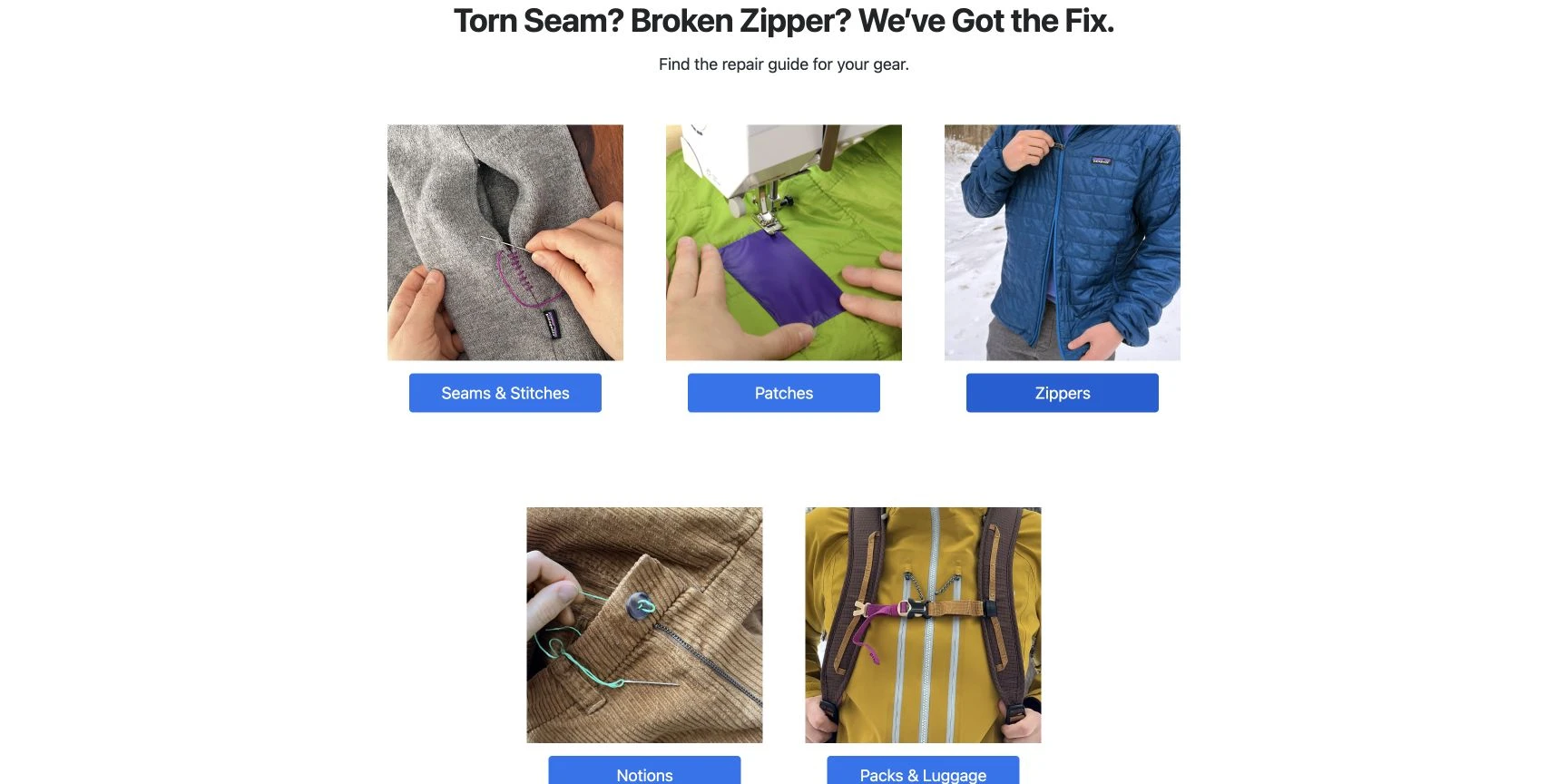
Patagonia’s repair hub gives worn garments a practical next step: care guidance and routes to instructions for seams, patches and zippers. The useful communication is the service itself, made easy to find.
For a furniture or lighting brand, the equivalent might be a care guide, a replacement-part route or a clear explanation of what can and cannot be repaired. Muuto’s product FAQ, for example, directs professionals to spare parts and product-specific care information. Do not turn the existence of a support page into a claim that every product is repairable.
A claim gets stronger when its boundaries are clear
The examples below are writing exercises, not claims about either brand. Open a claim to see what information is missing.
“Our packaging is sustainable.”
Ask for: the component, material, measured proportion, products covered, source and date.
A more useful structure: “The outer carton for [named range] contains [verified proportion] recycled fibre by [measurement basis]. See [dated specification].”
Do not fill in a percentage without evidence. Information about a carton does not describe the product inside it.
“Designed to last a lifetime.”
Ask for: the test, warranty terms, repair options, exclusions and expected conditions of use.
A more useful structure: name the part that can be replaced, explain how to order it and link to the relevant warranty or care information.
A reassuring phrase should not outrun the support the brand actually provides.
“Lower-impact production.”
Ask for: lower than what, which impact, which process, the comparison period and how it was measured.
A more useful structure: describe the documented process change and its scope. If the team cannot support the comparison, remove “lower” and report the action without inventing a benefit.
Build the evidence into the page
What changed, in plain language.
Which product, component, market and period.
A specification, report or defined certification scope.
Who checks the copy when the facts change.
Keep the essential qualification beside the claim. Use a longer page for supporting detail. A campaign should not lose a limitation that appears on the product page simply because the caption is shorter.
A short check before the campaign goes out
An editorial checklist, not a compliance certification. Selections are not submitted.
The UK CMA’s Green Claims Code checklist is a useful reference on clarity, evidence and scope. Requirements depend on the market and claim. Specialist review may be needed before a campaign runs.
Give the customer something they can check.
FORTUNE helps brands turn documented product information into brand communication, product pages and campaigns. Discuss the evidence behind your next story.
Originally published October 14, 2024. Updated October 30, 2026. Patagonia and Muuto are independent editorial examples, not FORTUNE clients or environmental-performance audits. Screenshot: Patagonia / iFixit, shown for analysis of the repair navigation. Cover and sewing photograph: cottonbro studio, Pexels licence. This article discusses communication, not legal compliance.